I have visited three Tools of the Mind (TotM) sites: two schools within the district of Long Branch, New Jersey and another at the Children’s Aid Society in East Harlem, New York.
It will be a real challenge to assimilate learning and distil what might be most helpful for Scottish practice. My natural tendency (as has been highlighted to me before, not always in a good way!) is to organise an experience into frameworks and boxes. As I started my sorting activity here though (‘implementation factors’, ‘practice elements’, ‘keys to success’), I realised it was stripping out the experience itself. So, I have put the frameworks to one side (for now, they will return) because the experience really needs a story. And it has to start with Long Branch, since it was 1. My first observation of ToTM and 2. Provided most time for class observation.
Long Branch, 4th October 2016: Visit overview
I visited George L. Catrambone School Kindergarten class (mostly 5 year olds) and two further pre-kindergarten classes (3 and 4 year olds) at Morris Avenue School. I had some pockets of time to speak with the teachers during the classes (thank you again Ms Meghann Cavanagh, Ms Kathryn Stone and Ms Kerin Oliveri) and further time to interview (and record) Mary Alice, one of the Education Coaches (more info on that role to come). I had the real pleasure of being accompanied through the day by Dr Renee Whelan (Director of Early Childhood for Long Branch) who not only transported me around for the day and took me to a great local lunch spot but also answered my questions with the same enthusiasm they were asked, spent more time than I am sure she had sharing the assessment strategy and tools they have developed and facilitated my meeting with Joy Daniels (Depute Principal at George L. Catrambone), Roberta Freeman (District Administrator for assessment and accountability) and Dr Michael Salvatore (Superintendant of Schools). Discussions through the day were rich with enthusiasm, curiousity and a genuine desire to share insight, as like-minded people who want to make things better for their children.
The focus for the story that follows is on my first experience of observing TotM, Ms Cavanagh’s Kindergarten class at George L. Catrambone School, Long Branch. The visit to Morris Avenue School and the Children’s Aid Society were both remarkable and worthy of their own story. I will get to those. For now, TotM in Ms Cavanagh’s class at George L. Catrambone:
How it started
I arrived at the school on the edge of rude prematurity (8.30 for a 9.30 start). That would be the 4.30am wake-up; a result of residual jetlag, conviction I’d get lost navigating New York/New Jersey transport systems and an unexpected excited nerve similar to starting a new job.
The taxi ride from the station highlighted the mix of demographics in the district; stretches of large three story detached houses with wrap around porches moving into areas of tired looking urban apartments, with kids of all races flying around on their bikes.
George L. Catrambone school itself was opened in 2014 and looked remarkably similar to the suburban American school I had imagined (complete with American flag). I was buzzed into the building and greeted warmly by one of three clerical staff. Her face, as I told her I was there as part of a study visit, told me she was not prepared for my accent or visit (a familiar indication that communication blocks in schools are universal). She met my introduction with a “You have a seat and let me find out”. The wait was a good opportunity to understand the school more: a parent called in and the clerical lady switched from a New Jersey accent to conversational Spanish; a sign on the Depute Principal’s door read “Be around the people you want to be like because you will be like the people you are around”; teachers poured out of a team meeting heading to their classes that would start at 9am. Ms Cavanagh was one of them. She stopped at the desk and was told her ‘student’ had arrived (I decided that was a compliment) and after some clarification, we walked through a few corridors together to the class. She felt immediately familiar. She asked if I had any questions, which I did, but didn’t want to interrupt plans for her class (and I was not sure what information she had been given). Her reply was “Don’t worry, we will make it work”. I liked her.
The class
Ms Cavanagh opened the classroom door and bounced in with “alriiight, boys and girls, I have my special visitor with me, her name is Mrs H, can you say it? Mrs ‘Huh’!”, as she blew the ‘huh’ into her hand. Her energy had just shifted from bubbly, friendly teacher I just met to 100% bounce with the personality of a Barney and Mrs Doubtfire hybrid. The kids’ faces lit up, now moving smoothly from sitting on the ‘homely’ carpet in three neat lines, to organizing themselves for movement. Upbeat music started and before I could get my bag and notepad down, everyone was dancing. So I joined in. Apparently this was the start of an activity, similar to musical statues, where they have to form the shapes on the card rather than be still as a statue (see pictures of stick drawings). These kids had done this before. I had not, but their super-intrigued-by-the-newbie faces were actually quite helpful as they spotted I needed help (“you have to copy the card Mrs Huh!”).
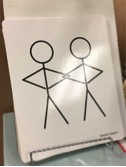
Cards used for initial movement activity
It really was like walking through a door, into Joy. The children were smiling, bouncing and seemed fully familiar with what was happening and expected. The adults (Ms Cavanagh and the class assistant, Ms Stewart) also looked like they were having a ball. Dancing alongside the children, enjoying the class with them.
After movement, they settled back onto the carpet and were introduced to ‘Topic’: “What are some rules in your home?”. They were reminded of discussions about home they had had previously and asked to ‘Double Talk’, that is, turn to their partner, tell them two rules from their home, then switch, listen to their partners rules and one of them might be asked to tell the teacher in a few minutes. Five year olds were sharing with each other, relevant to the task set and I overhear some self-checking from one partnership “We need another one, remember? Two”. When Ms Cavanagh asked for volunteers to share, one girl shared her home rule is to “answer in English”.
Around now, Dr Renee Whelan joined the class. Renee is the Director of Early Education in Long Branch and was instrumental in implementing ToTM in Long Branch over the three years it has been running there. She quietly introduced herself to me and shared her plans to use the time in class to do a required, formal observation of ToTM teaching. She also let me know that the focus within this kindergarten year for ToTM is really to encourage vocabulary development.
Double Talk lasts about 10 minutes and the transition to literacy involves more movement and a quick song (“point to the window, point to the floor, point to the ceiling, point to the floor!”) followed by lots of giggles. The giggles and energy are settled as the children are directed to sit on the carpet again, followed up by: “Ok, boy and girls lets ‘caaaaaalm’”, as Miss Cavanagh extends the word, she gestures her hand slowly from in front of her forehead down to her chest, which the children copy. The intended result is quite instant.
Literacy lesson
“Calm. We are ready” she repeats quietly and the literacy lesson is introduced. A reminder of the book title is given (“The Knight at Dawn”) and reference made to a small comic book strip style picture with the question “so, what do we know?”. Renee tells me that this book is usually used in second grade (P3). I had wondered as it looks like a book with chapters.
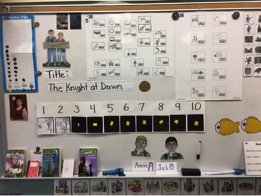
Comic strip pictures (running 1-10), with chapters 1 and 2 completed.
As Ms Cavanagh starts reading, it becomes apparent that there are props all around the classroom which she brings to life. In the corner is a floor to wall tree with home made characters in a treehouse, a castle over the other side of the room, a box of home made props such as shields and masks and an actual ‘flashlight’ at the front of the class. As she reads the chapter (one chapter per day will be read this week), Ms Cavanagh doesn’t just ‘do voices’ (and very well), she acts out the story. As the story references the castle, she stands up and looks over at it and invites the whole class to do the same (which they do with amazement). When the story references the characters using the flashlight (torch), she acts that out with her flashlight. When the story references one of the two characters, she has a mask for each one. It is brought to life and the children look 100% enthralled.
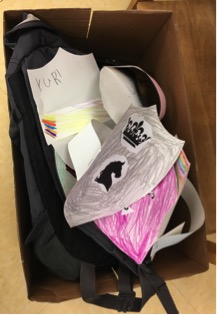
Some props to support literacy lessons
The story telling lasts no more than 10 minutes, after which the children are asked to think about what the characters might be feeling at certain points in the story. “Stop and Think. We know a bit about Annie’s personality, what might she been feeling?” And when the answer was a resounding chorus of “happeeee”, she adds “yes, I think so and I am also wondering about the other word we thought about, excited. Do you think she would be excited and happy?”.
They then stand up in a circle and Ms Cavanagh and Ms Stewart act out the part of the story they have just discussed, voices and involvement of the children as ‘horses’ (again, with head gear). They are encouraged to make whinny noises (which they had practiced the week before). The room is alive and the children look like they are having a lot of fun.
The children are brought back to the carpet and asked to provide a summary of what happened in the chapter (based on the animated reading of the story and the drama enactment) so that Ms Cavanagh can draw a picture on their comic strip (see pic) (she takes John’s critique well – that she has drawn a dog instead of a horse!). The next task was to generate a sentence about the chapter, which today was: “Jack and Annie went to the castle”. It starts with line matching. Ms Cavanagh marked a line on the white board for each word as they all try to repeat the sentence out loud. The line length roughly matched the word length. As a class they then recite the sentence and she writes the words on the lines, with some support to get the new words correct (this time John prompts her to use their ‘word fish’ for the word ‘castle’). Next, the ‘sparkle clips’ (class helpers for the week), adorn their actual sparkle clips (clothes pegs painted with sparkly silver paint) and get the tables organized for writing while the others are brought further into the carpet by a softly sung song with lyrics something like “come closer if you can’t hear my voice, come closer if you can’t hear my voice”.
The children were then asked to split into their groups and looked busy immediately. Each child had the same blank template with sections to attempt their name, a drawing, line making and any writing. They each retrieved their personal laminated letter-sound card from the back of their chair (see pic) which they would use to identify sounds and copy from, where they could. Ms Cavanagh and Ms Stewart moved round the class, checking understanding and assessing ability and progress quickly. Renee points out the letters down the side of the template to me: ‘P’ for Picture, ‘M’ for Message, ‘L’ for Line, ‘IS’ for Initial Sound, ‘ES’ for End Sound, ‘MS’ for Middle Sounds and ‘AP’ for Alphabetic Principle (an indicator that the child is ready for formal guided reading instruction. TotM teaches encoding before decoding). She explains that the teacher and assistant will circle the letter that best indicates what the child has managed, for example, if the child has managed to draw a picture of the sentence (P), tell the teacher what it is (M) and write the first letter of the key words (IS), the ‘IS’ box will be circled. The teacher and assistant look at these every day and agree how to support the child for that day to either secure that skill or be moved onto the next one.
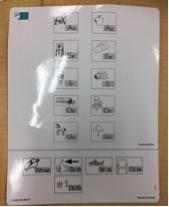
Letter-Sound Card
The writing ‘portion’ lasts about 15-20 minutes and within that time, I enjoyed moving around the room observing the effort and resulting products. I had a visit from one little girl, brimming with pride who excitedly showed me she had written the word ‘castle’. She had indeed.
Tidy up and goodbye
To finish literacy time, Pharell Williams “Happy” started playing and Ms Cavanagh started dancing on the carpet again. All of the children started tidying their letter cards, writing sheets and pencils, organized themselves and made their way over to start their dancing too.
Just before I left for the next class visit, I was given some time to share my Scottish gift with the class; a tea towel with a ‘Wee Hug’ poem on it. I introduced myself asking if anyone could guess where I might be from (“Somewhere near Ireland?” Good guess) then read it through, stopping once or twice to ask if they could guess what the word meant (e.g. Airms (arms). Their good guess was ears!). At the end, Ms Cavanagh suggested they turn to the person next to them and give them a ‘wee hug’ as she gave one to me.
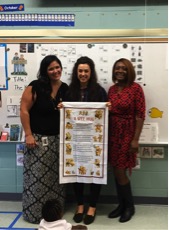
Ms Cavanagh, me and Ms Stewart.
Renee, Joy and I left the classroom for the next part of my day. What a pleasure it was to spend time in that classroom. It was an environment entirely set up to meet the educational needs of the children, who really did look like they were thriving. An experience I will always remember I am sure.
I will not have managed to do sufficient justice here to the quality of teaching and simple brilliance that I saw in the ToTM curriculum. As an initial attempt to crudely summarize key success factors in that room, I would highlight:
- The enthusiasm and skill shown by Ms Cavanagh and Ms Stewart to create and enter a world that would ignite the imaginations and potential of their children to engage and enjoy learning. They brought the curriculum to life in multiple dimensions. Despite there being several activity transitions through the morning, Ms Cavanagh was always a clear leader. There was clear skill here in her ability to seamlessly integrate opportunities to teach new material, elicit prior learning, build vocabulary and help them organize their experience.
- The design of the Tools of the Mind curriculum supported that in providing a structured, scaffolded curriculum rich in opportunities for physical and cognitive self regulation skill practice. Children were allowed to get used to the structure of the curriculum over time. Most of this class had had at least one year of prior experience of the TotM experience.
- None of the key or new messages relied only on verbally delivered instruction or information, unless the verbal messages had been rehearsed scripts (e.g. ‘popcorning out’ to mean shouting out). Props and actions seemed an integral part of the learning environment and were often developed with the children.
- Everything was delivered with a sense of fun e.g. ‘criss cross apple sauce’ (meaning cross your legs).
- Children were spoken to warmly, never spoken down to.
- Children were assumed to be interested in, and were taught about, vocabulary relevant to what they were learning about even though it might usually be assumed to be too advanced and reserved for later stages (e.g. medallion).
There is more detail to share about the TotM curriculum I observed, but here are a few more details on some of the elements mentioned above:
Teacher observation
TotM teachers are observed in their practice regularly by Renee and/or Early Education coaches (more details available). The observations are based on TotM curricular areas and offer an opportunity for a coaching conversation with the teacher, with follow up goals and targets to work on to improve the learning experience for the children.
Supporting Additional Support Needs
English was not the first language for sixty percent of Ms Cavanagh’s class. She indicated that there is a wide range of ability and needs within the class. I plan to ask for more details on the specifics but when I have asked each of the teachers about how TotM ‘works’ for children with additional needs, each spoke as if inclusion was fully part of the curriculum design. TotM themselves also provide appendices of suggested adaptations within the curriculum manual.
Literacy lessons/planning
Books in TotM are taught in three-week blocks. The first week is called Background Building where the children explore the life and times of the Magic Tree House chapter book they will read in weeks 2 and 3. They create props and role play to build comprehension and supplement their learning by looking up other relevant material e.g. YouTube videos. During the second and third weeks, the children read a chapter a day (10 in total), with a different comprehension strategy used each day (e.g. prediction), followed by their chapter summary with the scaffolded writing approach and through acting out the chapter with their peers and props.
Class size
There were 19 children in Ms Cavanagh’s kindergarten class. Pre Kindergarten 3 and 4 year old classes are capped at 15 children with the requirement to have a teacher and assistant in each. This is not just to support TotM, but is a state requirement.
October 8, 2016 at 11:58 pm
Hi I am John’s Mom, Jen… He is telling me that he wants to go to Scotland and see all the old castles even though all the kings and queens died! I am so glad you ot to experience the fun of learning in his class. Mrs. Cavanagh is one in a million as you saw!
October 9, 2016 at 12:11 am
That’s great Jennifer, John and the class were such a pleasure to meet! Do encourage him to come to Scotland and look me up when he does 😊